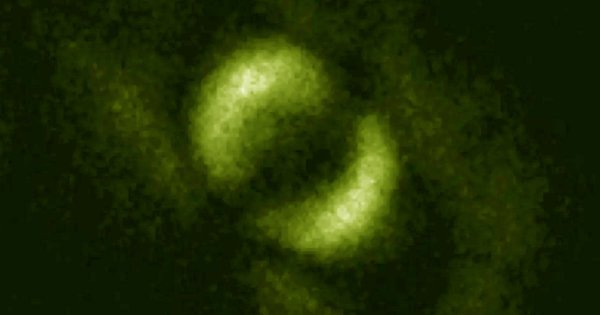
In a groundbreaking achievement, physicists at the University of Glasgow have captured the first-ever photographic image of two photons linked by quantum entanglement. The image, published in the journal Science Advances on Friday, provides visual proof of a phenomenon that has long been a cornerstone of quantum physics but had never before been directly imaged.
The experiment, led by physicist Paul-Antoine Moreau, involved a highly intricate setup. The team rigged a camera to capture 40,000 frames per second, operating in complete darkness at a temperature of -30 degrees Celsius. After sifting through thousands of frames, they identified the telltale signs of entanglement—where two photons instantaneously affect each other's state, regardless of the distance separating them.
Moreau described the image as "an elegant demonstration of a fundamental property of nature, seen for the very first time in the form of an image." He added that the result could "advance the emerging field of quantum computing and lead to new types of imaging."
Quantum entanglement, once called "spooky action at a distance" by Albert Einstein, is a phenomenon where particles become interconnected such that the state of one instantly influences the other, even across vast distances. While the concept has been experimentally verified for decades, capturing it visually has been a formidable challenge.
Why This Image Matters
The successful capture of this image is more than a scientific novelty. It offers a tangible representation that could help researchers better understand and manipulate quantum states, which is crucial for developing quantum computers and secure communication systems. The ability to visualize entanglement may also lead to new imaging techniques that exploit quantum properties.
The University of Glasgow team's work is part of a broader effort to harness quantum mechanics for practical applications. Quantum computing, for instance, promises to solve problems that are currently intractable for classical computers, while quantum cryptography could offer unbreakable encryption.
This milestone is a testament to the ingenuity and persistence of the research team, who overcame significant technical hurdles to achieve this first-of-its-kind image. As the field of quantum technology advances, such visual evidence will likely become an invaluable tool for both education and research.