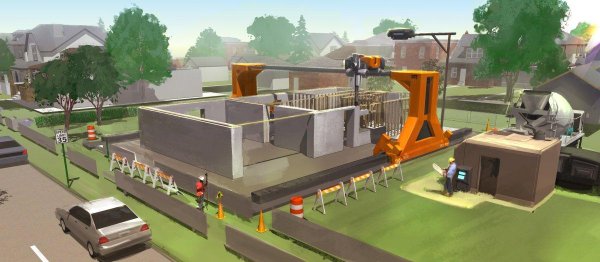
In a development that could reshape residential construction, a robotic system developed at the University of Southern California can now print a complete home on-site in under a day, including its electrical, plumbing, and air conditioning systems. The technology, created by Contour Crafting (CC), reduces a typical 2,500-square-foot home to just 19 hours of printing time, a stark contrast to the six to nine months currently averaged for U.S. homebuilding.
The system operates at a rate of about 20 seconds per square foot, embedding essential utilities directly into the structure during the printing process, eliminating the need for separate manual installation. According to the company, the entire construction process is streamlined into four steps, though it is not fully autonomous; a team of four people is required to oversee the machinery.
Contour Crafting offers different machines tailored to various building types. A multi-nozzle machine handles large commercial structures, a multi-story machine is designed for tall skyscrapers, and a standard printing machine is used for single detached homes. This versatility suggests the technology could extend beyond residential buildings to bridges and other infrastructure.
From Lab to Neighborhoods
The technology was developed under the direction of Dr. Behrokh Khosnevis at USC, who has long championed what he calls layered fabrication. The company aims to apply this method to commercial projects of all sizes, with the goal of significantly reducing both construction waste and costs. Khosnevis believes that towers, bridges, and other infrastructure could be built at a fraction of the usual time and expense.
The system also supports customization, including rounded structures such as pipes and tunnels, which are typically difficult to construct with conventional methods. Khosnevis has expressed plans to introduce the technology to entry-level construction models within the next one to two years, and envisions entire neighborhoods of 3D-printed homes.
In the nearer term, the founders see a practical application in disaster relief, where speed is critical. The ability to print a habitable home in less than a day could provide rapid shelter for communities affected by emergencies, a scenario that aligns with the technology's potential for on-demand construction.
While the system is not yet fully autonomous, the reduction in labor and time could have significant implications for the construction industry, which has been slow to adopt automation. The company's focus on integrating utilities during printing addresses one of the most time-consuming and costly aspects of traditional building.
As the technology moves toward commercialization, its impact on housing affordability and speed remains to be seen, but the prospect of a complete, move-in-ready home printed in under 24 hours marks a notable shift from conventional building methods.