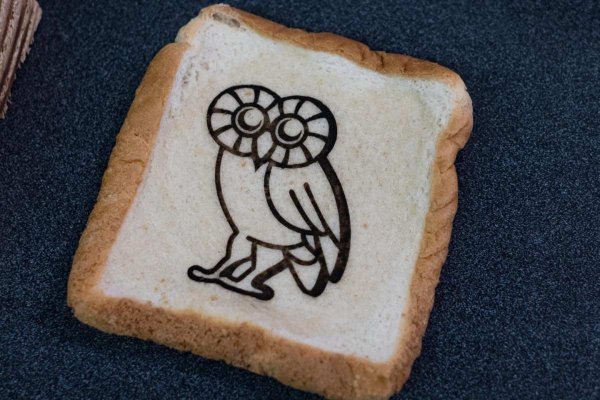
In a development that could turn the humble potato into a tracking device, scientists at Rice University have demonstrated a method to etch graphene patterns directly onto food items, creating edible electronics that can store data and sense contamination. The technique, detailed by the lab of chemist James Tour, uses a laser to convert the surface of materials like toast, coconut shells, and potatoes into graphene, a one-atom-thick carbon lattice with remarkable electrical properties.
The process, known as laser-induced graphene (LIG), does not rely on inks or added materials. Instead, it transforms the carbon already present in the object into graphene. “This is not ink,” Tour said in a statement. “This is taking the material itself and converting it into graphene.” The conversion happens at room temperature, making it safe for food items.
The resulting tags are composed of just a few layers of graphene and can function as supercapacitors, biological sensors, radio-frequency identification (RFID) antennas, or even electrocatalysts for fuel cells. Beyond food, the team has successfully imprinted these patterns onto paper, cardboard, cloth, and cork, suggesting a wide range of potential applications.
From Cookies to Circuits
This is not the first time Tour’s lab has merged culinary and scientific pursuits. In 2011, the group famously converted Girl Scout cookies into graphene, hinting at the versatility of the technique. The current work, however, focuses on practical uses, particularly in food tracking and safety.
Tour envisions a future where every food item carries a tiny RFID tag directly on its surface, providing consumers with detailed information about its origin and journey. “Very often, we don’t see the advantage of something until we make it available,” he said. “Perhaps all food will have a tiny RFID tag that gives you information about where it’s been, how long it’s been stored, its country and city of origin, and the path it took to get to your table.”
The tags could also serve as an early warning system for foodborne pathogens. If bacteria such as E. coli are present, the sensors could “light up and give you a signal that you don’t want to eat this,” Tour explained. “All that could be placed not on a separate tag on the food, but on the food itself.”
While the concept is promising, the researchers have not yet addressed a key question: how do these edible electronics taste? For now, the focus remains on the technology’s potential to enhance food safety and traceability, a pressing concern in an era of complex global supply chains.