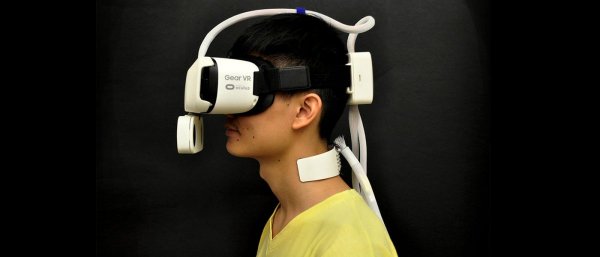
Virtual reality has long focused on delivering crisp visuals and spatial audio, but a team at the National University of Singapore is pushing the envelope by adding physical sensations to the mix. Their latest creation, Ambiotherm, is a compact accessory that lets users feel wind and heat while immersed in virtual environments.
The device, developed under the leadership of researcher Nimesha Ranasinghe, consists of two modules. A wind module, attached to the underside of the VR headset, uses a pair of fans to generate airflow across the wearer's face. A separate temperature module, worn at the back of the neck, can produce warmth. Together, they aim to mimic the physical conditions of scenarios such as walking through a sun-scorched desert or skiing down a cold mountain slope.
According to the team, gradual adjustments to each module can simulate the way the body would naturally experience changing environmental conditions. This approach is a departure from earlier attempts, which relied on bulky fans and heat lamps placed around the user. By scaling down the hardware to fit on the headset and neck, the researchers have made it possible to integrate these sensations into a more portable VR setup.
The project builds on the group's prior work in multi-sensory VR. Last year, Ranasinghe and his colleagues demonstrated a technique using electrodes to add a sense of taste to virtual experiences. Ambiotherm extends that concept by addressing the sense of touch through thermal and airflow feedback.
Expanding the Sensory Palette
The researchers are not stopping at wind and temperature. Their roadmap includes incorporating smell and vibration into VR, as well as investigating how human emotions can be influenced and applied to multi-sensory virtual environments. These efforts reflect a broader trend in VR research toward engaging more than just sight and sound, aiming to create experiences that feel more real and emotionally resonant.
While the current prototype is a research demonstration, the potential applications range from entertainment to training simulations where environmental cues matter. The compact design could eventually make such sensory feedback more accessible to consumers, though commercial availability has not been announced.
As VR continues to evolve, the integration of physical sensations like wind and heat represents a step toward more immersive digital worlds. The National University of Singapore team's work highlights the growing importance of multi-sensory feedback in shaping how users perceive and interact with virtual spaces.