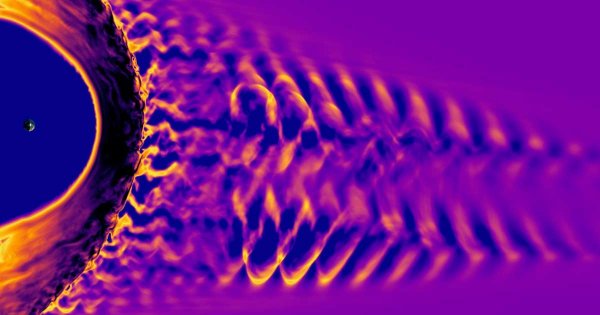
A solar storm crashing into Earth's magnetic field produces a far more intricate pattern of magnetic waves than previously understood, according to a new analysis by scientists at the University of Helsinki. The team, led by researcher Lucile Turc, used data from the European Space Agency's Cluster mission—a four-spacecraft constellation that has been investigating Earth's magnetic environment—to map these waves and translate them into an audible 'song' of bleeps and bloops.
The findings, published in a statement from the university, focus on the 'foreshock' region, the area where particles from a solar storm first interact with Earth's magnetic shield. By examining this zone, the researchers discovered that the magnetic waves generated are considerably more complex than expected. Turc noted that while a change in frequency was anticipated, the level of complexity in the wave was not.
Solar winds are a constant stream of charged particles released by the Sun. A solar storm, also known as a coronal mass ejection, is a more violent eruption of plasma, driven by a sudden release of magnetic energy. These storms are powerful enough to temporarily deform Earth's magnetic field, which is the protective bubble that shields the planet from the harshest effects of solar radiation.
Why This Matters for Space Weather
The research has practical implications for understanding space weather disturbances, which can disrupt satellites, communication systems, and power grids on Earth. By better characterizing the magnetic waves produced during solar storms, scientists could improve forecasting and mitigation strategies for these technological impacts.
Beyond our planet, the findings could offer insights into the magnetic fields of distant exoplanets. By studying how a parent star's activity affects a planet's magnetic environment, researchers might infer details about exoplanetary magnetic fields and their potential to shield atmospheres from stellar radiation.
The Cluster mission, launched by the European Space Agency, has been instrumental in studying the Earth's magnetosphere for over two decades. The four spacecraft fly in a tetrahedral formation, allowing for three-dimensional measurements of the magnetic field and charged particles in space. This unique capability enabled the team to capture the detailed wave patterns reported in this study.
While the audible representation of the waves is a striking byproduct of the research, the underlying data provide a richer understanding of the dynamic interactions between solar storms and planetary magnetic fields. The team's work underscores the complexity of space weather and its potential effects on both terrestrial and space-based technologies.