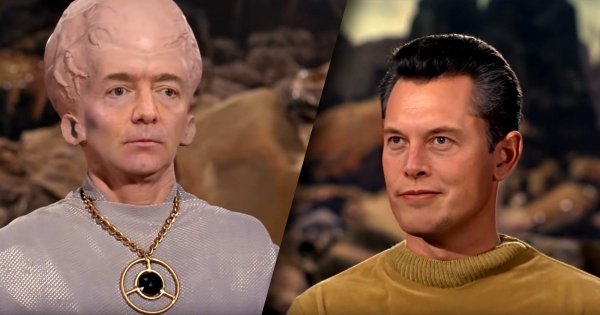
A newly surfaced deepfake video places Amazon founder Jeff Bezos and SpaceX chief Elon Musk into the 1965 pilot episode of the classic science-fiction series “Star Trek,” with Bezos transformed into a Talosian alien whose veiny head has drawn particular attention. The clip, which has circulated online, demonstrates the growing sophistication of AI-driven face-swapping technology even as experts continue to warn about its potential for abuse.
The video, shared on YouTube, reimagines the original “The Cage” pilot by inserting the two tech billionaires into scenes originally featuring the show's characters. While the effect is largely playful, the visual of Bezos as a Talosian—a fictional alien race known for their enlarged, veined craniums—has been described by some viewers as unsettling.
Deepfakes are created using neural networks that learn to map one person's facial expressions and movements onto another person's body, producing realistic but fabricated footage. The technology has advanced rapidly in recent years, making such manipulations increasingly difficult to detect with the naked eye.
Beyond the Novelty: Real-World Concerns
Although this particular deepfake is intended as entertainment, the underlying technology has raised alarm among policymakers, researchers, and the public. One of the most prominent concerns is the use of deepfakes to create nonconsensual pornography, where celebrities' or private individuals' faces are superimposed onto explicit content without their permission. This practice has become a widespread issue, with numerous reported cases involving public figures.
Another major worry is the potential for deepfakes to be weaponized for disinformation. By making it appear that a politician or other public figure said something they never actually said, malicious actors could spread false narratives and undermine trust in media and institutions. So far, this scenario has largely remained theoretical, with few verified instances of deepfakes being used in large-scale misinformation campaigns.
Nevertheless, the rapid improvement of deepfake technology has prompted calls for stronger legal frameworks and better detection tools. Some platforms have already implemented policies to label or remove synthetic media, and researchers are developing forensic methods to identify manipulated videos.
For now, the Bezos-Musk Star Trek clip serves as a vivid illustration of both the creative possibilities and the ethical dilemmas posed by AI-generated content. As the technology becomes more accessible, the line between reality and fabrication is likely to blur further, making media literacy and robust safeguards all the more critical.